Wildeshausen · Amsterdam · Java · 1807–1893
The life of Johann Joseph Lambert Knagge (1807–1893) — known to his family simply as Lambert — was a nineteenth-century odyssey that carried him from a small Lower Saxon town to the plantations of the East Indies and back, transforming a provincial boy into a global merchant prince.
The Blow That Set a Path
Lambert’s journey began with a moment of trauma that would come to define his resilience. A gifted student in Wildeshausen, he was struck so violently by a brutal teacher that he lost the hearing in one ear for the rest of his life. The injury never dampened his spirit; if anything, it seemed to fuel a restless energy. After a string of professional setbacks in Europe — dismissed from an Amsterdam firm for refusing to perform menial labour, then cheated by an English business partner — he found himself on an Amsterdam street corner, all but penniless, with just 1,000 guilders to his name.
A Fateful Meeting and the Great Voyage
His fortunes turned in a scene worthy of a Victorian novel. Dining at his usual restaurant, he was approached by S. Zellweger, a Swiss textile merchant searching for an agent bold enough to carry a shipment of fine lace and embroidery to the East Indies. Lambert did not hesitate. In 1838 he boarded a 500-ton sailing vessel bound for Batavia (today’s Jakarta).
To undertake such a voyage in the 1830s was to vanish from the known world. The passage took 106 days — crossing the equator and rounding the Cape of Good Hope — with nothing but the wind and Lambert’s own wits to see him through.
The “Learned Wonder” of Samarang
On reaching Java, Lambert did what few European merchants of his day troubled to do: he immersed himself in the culture. He mastered Malay, then applied himself to three distinct Javanese dialects. To the local people he became a “learned wonder” — an outsider who spoke like an insider.
His commercial instincts were just as sharp. Where rival traders watched their cattle hides rot in the tropical heat, Lambert pioneered a method of salting hides for shipment to Europe, earning a guilder on every one. It was the making of him: he grew immensely wealthy, in time managing sugar plantations and branches of his firm across the island.
“The local people viewed him as a learned wonder — an outsider who spoke like an insider.”
The Princess and the Tiger
Lambert’s place in Javanese society was sealed by his marriage to Lamia Bodjouorogo — remembered in the family as the daughter of a local Radja, or prince. (Her name survives only through family tradition, and is elsewhere recorded as “Pamina”; the archive still treats it as an open question.) One story captures the exotic drama of those years: during the wedding celebration a tiger is said to have broken into the party and slightly wounded the groom — a scar Lambert wore ever after as a memento of his new life.
Tragedy shadowed the success. Shortly after the birth of their daughter Josephine — “Phina” — in 1848, Lamia died in childbirth. Left alone with an infant in a climate that was turning against his own health, Lambert was eventually stricken with scurvy and warned that he must return to Europe or die there.
Survival in the Channel
His return voyage of 1851 proved even more perilous than the journey out. The ship was battered for 22 days by a storm that snapped her masts and left the crew drinking foul, worm-ridden water. Then, nearing the English Channel in thick fog, she collided with another vessel. As his ship began to sink — gone within twenty minutes — Lambert acted with desperate courage: he strapped his small daughter to the back of her native nurse and jumped. They were pulled from the water, together with his trunks of valuables, moments before the ship disappeared beneath the waves.
The “Knaggerei”: A Dream in Stone
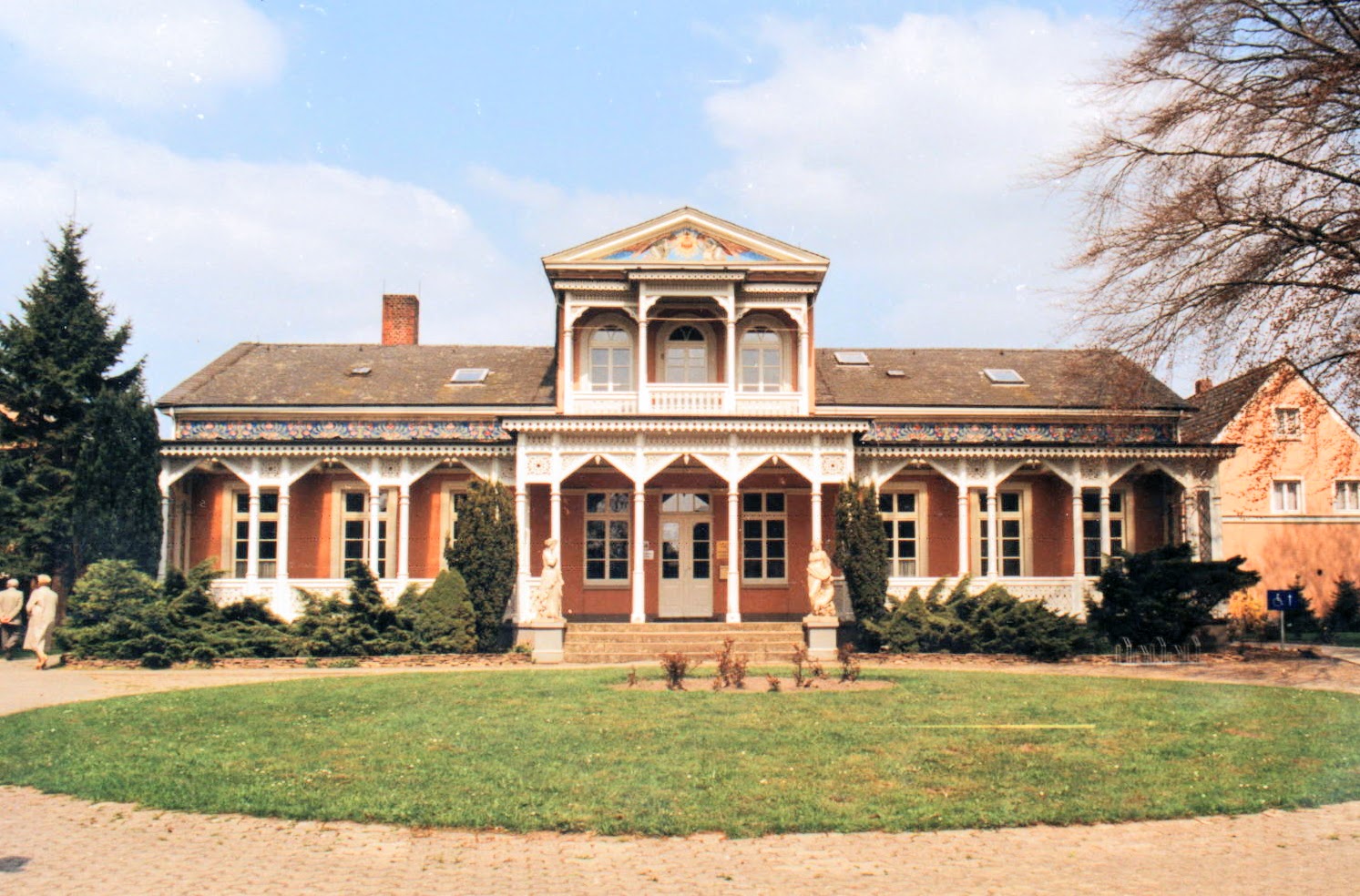
Lambert came back to Wildeshausen not as the boy who had left, but as a man of the world. He bought ten Morgen of land and set about building a home to match his adventures. The result was the Villa Knagge — known locally as the “Knaggerei.” In a town of plain German houses it was a marvel, folding Javanese elements — a sweeping wooden veranda, exotic motifs — into a grand, late-classical design.
He lived another four decades there: a lucid, energetic patriarch who read the daily paper without spectacles until his death at eighty-five. His children carried the fortune and the stories he brought home from the East into new family branches in Munich and Australia.
The house outlived him by more than a century. Sold to the parish of St. Peter in 1968 and later serving as a kindergarten and social centre, the Villa Knagge passed in 2020 to a private owner who took it on for preservation — the merchant prince’s dream in stone, still standing in Wildeshausen.